Culture & Etiquette in Sri Lanka - Local Knowledge
Content reviewed by Dilshan-H
Published: 23 May 2026 - Updated
Sri Lanka is a deeply spiritual and community-oriented country. Here on SriGuide, we share the etiquette that locals genuinely appreciate - not a rulebook you’re required to follow. At the end of the day, it’s your trip and your comfort level. We understand and respect that not everything here will suit everyone.
But a little goes a long way. Even the smallest gestures like removing your shoes, offering a smile tend to open more doors than a full itinerary ever could.
Visiting temples & religious sites
Section titled “Visiting temples & religious sites”Sri Lanka is home to Buddhist temples (viharas), Hindu kovils, mosques, and colonial-era churches - often within a short walk of each other. Each has its own expectations, but a few rules hold almost everywhere.
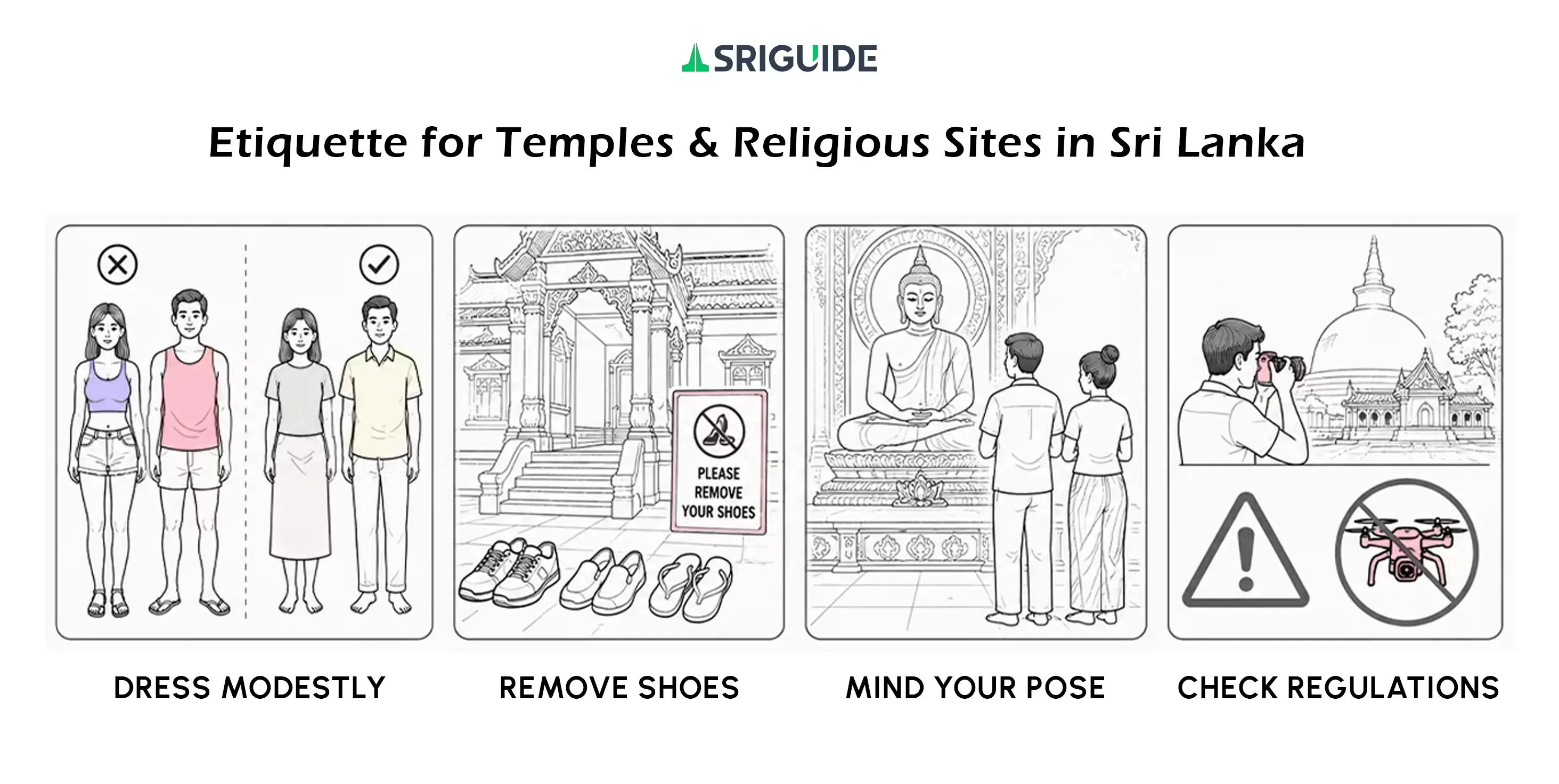
- Dress modestly: Cover your shoulders and knees regardless of gender. Many popular sites sell or lend sarongs at the entrance if you arrive underprepared. Light colored clothing is much preferred.
- Remove your shoes: Always, before stepping onto temple grounds. You’ll see a rack or a pile near the entrance. Socks are fine but often not needed. If the ground is hot stone in midday sun, that’s part of the experience!
- Mind your body language around statues: Don’t pose with your back to a Buddha statue for photos. It’s considered disrespectful. Avoid pointing your feet towards shrines or monks, and don’t touch statues unless explicitly invited to.
- Follow the direction of worship: In Buddhist temples, circumambulation (walking around a stupa or shrine) is done clockwise. Watch what others do when in doubt.
- Local customs may vary: In some shrines/kovils there might be separate rules for visitors. For example;
Nallur Kandaswamy Templerequires male devotees visiting the inner temple precincts to remove their shirt/tops before entering.
A few words of Sinhala
Section titled “A few words of Sinhala”Sinhala (සිංහල) is the first language of most Sri Lankans outside the Northern and Eastern provinces, where Tamil (தமிழ்) dominates. English is widely spoken in tourist areas, but a handful of words in the local language will earn you a noticeably warmer reception.
Ayubowan — which means ‘May you live long!’ offered with palms pressed together is the traditional greeting and acts as a gesture of respect. You’ll see it used at arrivals halls, ceremonies, and between elders. Using it in return is always appreciated. But among today’s younger generation, this gesture is fading away and is now limited to ceremonies or special occasions.
You can tap on any of the cards below to listen to the pronunciation as well.
If you want to learn more phrases make sure to check out the Sinhala Phrasebook on Wikivoyage hosted by the Wikimedia Foundation.
Nightlife
Section titled “Nightlife”Sri Lanka’s nightlife is more varied than its reputation as a spiritual destination suggests. Most activities are concentrated in towns and urban areas. Rural communities also host nighttime events, but they tend to be less frequent and focused on local gatherings. Here, we’ll discuss nightlife in town areas. You should be mindful of local customs and regulations since Sri Lanka is still relatively conservative.
Colombo
Section titled “Colombo”Colombo’s nightlife is concentrated in its urban districts. There are many bars, rooftop bars and restaurants open at night times and you can easily find them along the coastline. Musical events and parties are generally shared through social media platforms, advertisements or notices on hotels/guest houses. The crowd includes both locals and visitors, and evenings are typically calm rather than rowdy.
Beach towns
Section titled “Beach towns”Mirissa, Hikkaduwa like beach areas on the south coast have beach parties and bars that run late, peaking during the November – April tourist season. Arugam Bay on the east coast has a more low-key surfer atmosphere — bonfires on the beach, not nightclubs.
Use of Alcohol, Tobacco and Drugs
Section titled “Use of Alcohol, Tobacco and Drugs”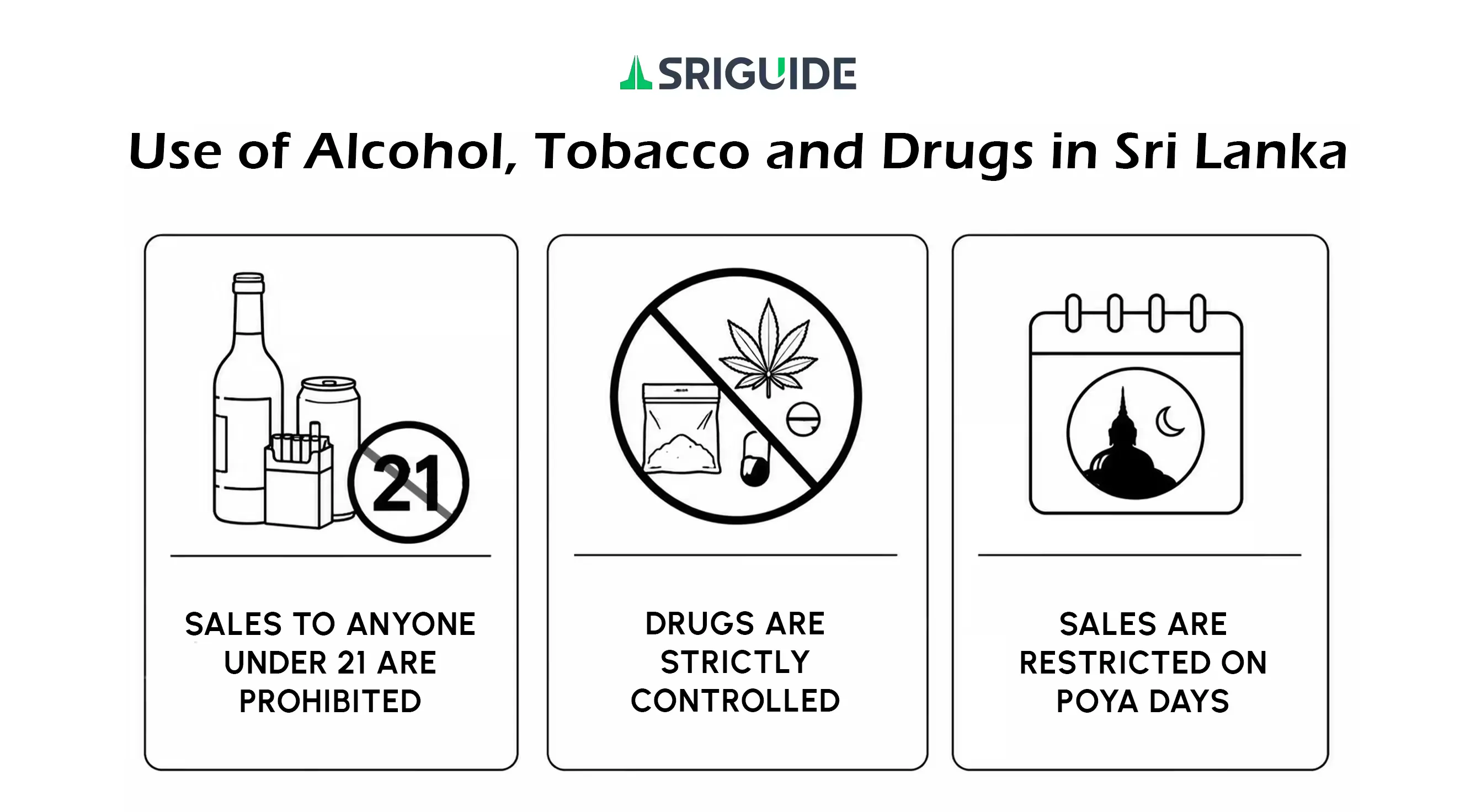
In Sri Lanka, alcohol and cigarettes are legal but regulated, and they are sold through licensed shops, bars, hotels, and restaurants. Sales to anyone under 21 are prohibited, and tobacco and alcohol advertising is restricted under national law. Drugs are strictly controlled, and possession, use, or trafficking of illegal drugs is punishable by law. It is best to avoid carrying any unknown substances, since drug enforcement is taken seriously.
In terms of Alcohol, the prices in restaurants tend to be higher than in local bars and sales are restricted on Poya days (monthly Buddhist holidays, once a month) Bars are limited in small towns and availability is higher in cities and beach areas.
Holidays in Sri Lanka
Section titled “Holidays in Sri Lanka”Holidays in Sri Lanka may affect opening hours, transport, and availability of services. Poya days and public holidays are especially important, so plan ahead when traveling. On Public holidays, most of the destinations will be closed and the transport services may not function at full capacity.
The following widget shows the holidays with category labels. There are 4 categories as shown here.
- Poya days are monthly full-moon Buddhist observances.
- Mercantile holidays mainly affect private-sector and commercial operations.
- Bank holidays apply to banks and related financial institutions.
- Public holidays are official nationwide holidays observed across the country.
Festivals
Section titled “Festivals”Sri Lanka’s festival calendar is dense and genuinely spectacular. If your dates overlap with any of the following, try to plan around them to avoid any inconvenience.
Sinhala & Tamil New Year Mid-April
The biggest cultural celebration of the year, which is celebrated by Sinhalese and Tamils. Families gather, traditional games are played, and specific foods are prepared at auspicious times. Shops and transport slow down for a day or two. Expect higher traffic in expressways, public transport methods couple days before and after the holidays.
Vesak May
Commemorates the birth, enlightenment, and passing of the Lord Buddha. Towns across the country are strung with lanterns and decorations. Strangers set up stalls offering free food and drinks on roadsides (dansalas) - accept them, it’s genuinely offered in a spirit of generosity.
Esala Perahera July–August, In Kandy
One of Asia’s grandest processions. Decorated elephants, drummers, fire dancers, and Kandyan dancers parade through the city streets over ten consecutive nights. Book accommodation in Kandy months in advance if you want to be there. Expect road closures and heavy crowds on roads around Kandy within these few days.
Christmas December
Sri Lanka has a significant Christian community, and Christmas is a public holiday observed broadly. Colombo and other major towns in particular decorate heavily on Christmas.
Food & eating
Section titled “Food & eating”Sri Lankan food is built around rice and curry, as a spread of small bowls placed around a mound of rice. Each adds a different flavour: a coconut-milk curry, a dry mallum, vegetables, a scoop of dhal etc. The combination is the meal.
Eating with your hand (with your dominant hand)
This is the traditional way and still common at home and in local restaurants. There’s a practical logic to it - mixing the curries into the rice with your fingers gives you more control over flavour. You won’t be expected to do it as a visitor, but it’s worth trying at least once. Use only your fingers, and avoid letting food touch your palms.
Don’t eat curries on their own
We don’t eat curries one by one - that’s a big no. Many tourists eat curries on their own and then complain that they are too spicy. Take a little of each curry and mix it with rice. That’s how we do it. If you want to go a step further, start mixing food from a corner of the dish, not the center.
Expect heat
Sri Lankan curries are genuinely spicy. If you have a low tolerance, it’s fine to ask for “less chilli”. In Sinhala language you can use following two phrases:
- Is this too spicy? - මේක සැරද?
mēka særada? - I’d like it not too spicy - වැඩිය සැර එපා
væḍiya særa epā
Most cooks will accommodate it without judgment. Mixing small portions of curries with rice works well to temper the heat.
Street food to seek out
You have to try out different street foods as a part of your experience here. But make sure to pick stalls where many people are buying items.
Just a few examples: Kottu roti (shredded rotis, vegetables, and your choice of egg, meat or cheese), egg hoppers (bowl-shaped rice pancakes with or w/o a fried egg in the centre), and isso vadai (fried vadai topped with prawns).
Be sure to check out our Food & Eats page for much more details!
Toilet/Bathroom Etiquette
Section titled “Toilet/Bathroom Etiquette”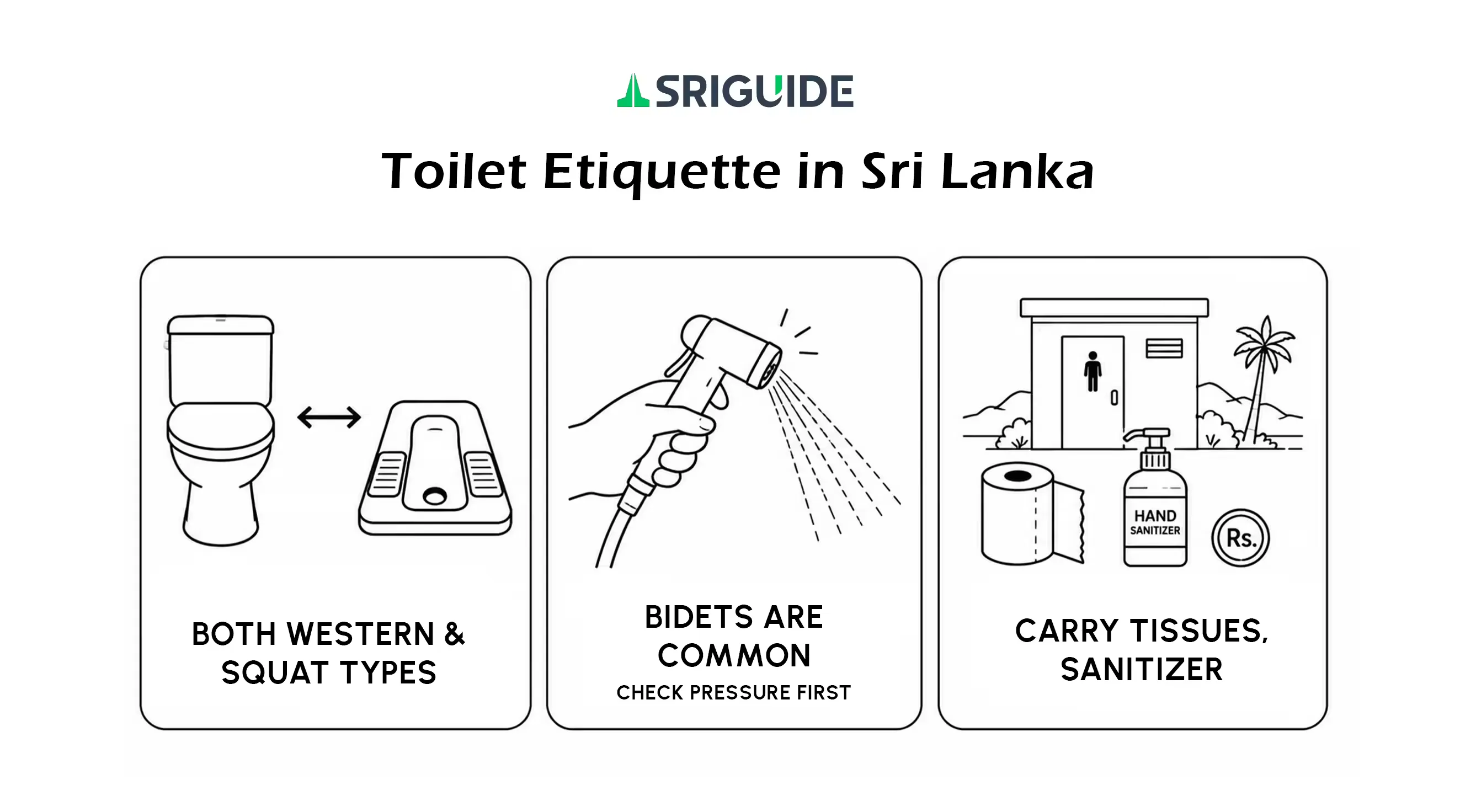
Facilities vary across Sri Lanka. Modern hotels and tourist attractions usually have Western-style toilets, while some public and rural restrooms may have squat toilets. It’s helpful to carry tissues and hand sanitizer, as supplies aren’t always available.
- Many Sri Lankan bathrooms have bidets (hand sprays) instead of/in addition to toilet paper. Be cautious of water pressure – Bidet sprays can have surprisingly strong pressure sometimes.
- Carry tissues & hand sanitizer, especially when traveling in rural areas.
- Public restrooms may be basic, not well maintained, and some may charge a small usage fee.
Respectful Behavior
Section titled “Respectful Behavior”- Avoid public displays of affection (holding hands okay, kissing not)
- Ask permission before photographing people
- Remove hats when entering religious sites
- Visible Buddha tattoos can offend; cover them
- Dress modestly in public places, as revealing clothing such as tank tops, bikinis are considered disrespectful to local cultural norms
Stance toward LGBTQ travelers
Section titled “Stance toward LGBTQ travelers”Sri Lanka has conservative attitudes toward LGBTQ issues. Same-sex relationships are illegal under local law, and public displays of affection may attract negative attention. Major tourist areas in cities like Colombo are generally more accepting, but it’s wise to be cautious in rural areas. But rest assured, nobody will make any trouble, and most places are welcoming as long as visitors are respectful.
© 2026 SriGuide - Free & Open Source
Project by